April 13, 2015

Intra-Trinitarian Love, the Church's Relational Model and Empowering Source


If God was unipersonal (one person), there would have been no love until he created the angels and human beings. However, if the world was created by a triune, tripersonal God, then relationships of love are what life is all about, defining God Himself and ultimate reality. Hence, God is not merely a participate in loving relationships; loving relationships are an intrinsic part of His eternal being. And, this intra-Trinitarian love is both the relational model and empowering source of love in the church. (Link to: Lesson Audio & Notes)

March 14, 2015

Heaven & Earth & Me

   This short video is an excellent summary of God's plans and purposes related to the cosmos. In American Christianity, this big picture perspective is, more often than not, found wanting.
   Accordingly, while it may be important for an individual believer to explore what God is doing within his or her personal life (e.g. within an individual believer's personal justification and sanctification), it is equally important for a Christian to explore what God is doing without, in re-creating heaven and earth (Mt 28:18; Col 1:20; Eph 1:10). Otherwise, a believer may become inadvertently stuck in a reductionistic model of Christianity that eventually proves lacking. And, unfortunately, such a believer's growth in future hope, a critical impetus in Biblical sanctification (1 Jn 3:2-3; Tit 2:11-14; 1 Pet 1:13-17), will remain anemic and underdeveloped.
   Finally, the "regeneration" that the Scriptures refer to involves both created/re-created believers (Tit 3:5) and the created/re-created cosmos (Mt 19:28). The same Greek word, "paliggenesia" ("regeneration"), is used in both of these passages (note: it is translated "new world" in the latter). And, essentially, it describes a spiritual rebirth or renovation, a Messianic restoration. In other words, individual believers, as a resurrected and glorified people, in a "a new heaven and a new earth" (Rev 21:1-3).     


February 6, 2015

Running on Empty

   Unlike many conservative Christians, I don't believe the Bible is the only source of God's truth when it comes to counseling troubled people (click here for a concise summary of what I believe: True Counseling). Consequently, I also (very discreetly) read secular authors to gain maximum wisdom and insight.
   Since I first read Daniel Goleman's book, Emotional Intelligence (around 1996), I've continued to be interested in this subject. In fact, this book has proven to be one of the most important books I've ever read. In its day, this book was "groundbreaking," and it continues to significantly influence the psychological profession. Per this book, Emotional Intelligence consists of five essential skills: knowing one’s emotions, managing emotions, motivating oneself, recognizing emotions in others, and handling relationships.

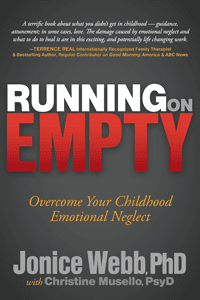
     Moreover, this past week, I finished reading the book, Running on Empty, by Dr. Jonice Webb. This book builds on Goleman's work in Emotional Intelligence, and it's, in a word, extraordinary. Within the psychological community, this author's insights are considered a rare breakthrough. In a nutshell, the book deals with the often undetected invisibility of Childhood Emotional Neglect (CEN). Here's a brief quote from the book that helps to introduce and define CEN:
"There is a good explanation for why Emotional Neglect has been so overlooked. It hides. It dwells in the sins of omission, rather than commission; it’s the white space in the family picture rather than the picture itself. It’s often what was NOT said or observed or remembered from childhood, rather than what WAS said."
If you're interested in further details, below are some links that will introduce you to Dr. Jonice Webb and her book, Running on Empty:
1) Dr. Jonice Webb PhD, (questionnaire/book)

January 17, 2015

The Power of Empathy

   This short, animated video helps illuminate the difference between an empathetic and sympathetic response to another person's angst. And, this is significant, because understanding this difference will often determine whether we aggravate or alleviate another person's pain. Empathy is more other-centered; sympathy is often self-centered. Hence, truly empathizing involves exiting and suspending one's own orbit of thoughts and feelings with a view to entering and dwelling within another person's orbit of perceptions and emotions (which is, by the way, a privileged entry into a very guarded, sacred place).
   Moreover, such patient listening should never be considered equal to acquiescing with the relativism of our day, wherein even legitimate, Biblical judging is strictly taboo. The patient (Scriptural) listener simply suspends judgment, understanding that it is God-like to lovingly enter into messy, human needs that are commonly buried under ugly, human sins (Rom 5:8).
   All that said, empathy isn't an easy gift to give, as, by nature, we are not other-centered, we are self-centered. Of course, Jesus Christ, in His incarnation, epitomized such self-forgetting love, so he is the ultimate model for His disciples to follow (Phil 2:3-8; Jn 13:34; Gal 6:1-2). Consequently, it seems to me that empathy should be the first gift we give to anyone we love that suffers, even if his or her unhealthy thinking and living needs some obvious re-alignment.


October 6, 2014

The Man, the Boy, and the Donkey (Aesop)


A Man and his son were once going with their donkey to market. As they were walking along by its side a countryman passed them and said: "You fools, what is a Donkey for but to ride upon?"
 

So the Man put the Boy on the Donkey and they went on their way. But soon they passed a group of men, one of whom said: "See that lazy youngster, he lets his father walk while he rides."


So the Man ordered his Boy to get off, and got on himself. But they hadn't gone far when they passed two women, one of whom said to the other: "Shame on that lazy lout to let his poor little son trudge along."


Well the Man didn't know what to do, but at last he took his Boy up before him on the Donkey. By this time they had come to the town, and the passers-by began to jeer and point at them. The Man stopped and asked what they were scoffing at. The men said: "Aren't you ashamed of yourself for overloading that poor Donkey of yours--you and your hulking son?"


The Man and Boy got off and tried to think what to do. They thought and they thought, till at last they cut down a pole, tied the Donkey's feet to it, and raised the pole and the Donkey to their shoulders.


Then they went along amid the laughter of all who met them till they came to Market Bridge, when the Donkey, getting one of his feet loose, kicked out and caused the Boy to drop his end of the pole. In the struggle the Donkey fell over the bridge, and his fore-feet being tied together he was drowned.


"That will teach you," said an old man who had followed them: "Please all and you will please none."


August 7, 2014

When Greatness Meets Emptiness


What happens when good things become ultimate things? In the end, they starve, enslave, and divide us. Human emptiness is a God-shaped void, even in the lives of notorious people like Michael Jordan. And, unfortunately, the last place we usually go to solve our pressing problems is to God, via the Scriptures, in the person of Jesus Christ. Bottom line, we would rather live in our disordered loves than seek real, satisfying answers. We are all worshipers, whether of good things, of ourselves, of evil impulses, or of God.


August 1, 2014

"Word of God" by Mian Situ

   I love this picture (a painting entitled "Word of God," by Mian Situ). It seems to be a painting that brings out the truths in the parable of the sower from (Matt 13:1-9; 18-23).
   A clergyman, looking heavenward, is declaring the Word of God to a diversity of hearers, some engaged, others partially engaged, and still others ignoring him. All of these people are on a voyage together. While a storm seems possibly brewing in the distance, it is not presently upon them. A lifeboat is vaguely in the background (note: click on it to enlarge).

June 19, 2014

Financial Advise From Jed Clampett?


Well, here's an unlikely source of good financial advise--but good financial advise it is! 21st-century Americans would do well to be as content financially as ole Jed. This is one of my favorite scenes from the old show, The Beverly Hillbillys.

June 4, 2014

Running the Race

"Do you not know that in a race all the runners compete, but only one receives the prize? So run that you may obtain it (1 Cor 9:24-25).


". . .let us run with endurance the race that is set before us, . . ." (Heb 12:1-3).


Here's a story that puts these verses in perspective.


The Future Forecasted in the Past


Some old pictures iconically point toward the future, and this is one of them. It's Winter, around 1971. I'm taking the picture (the shadow), and my 3 little brothers are working on our new "recreation room" (my grandfather and stepfather's do-it-yourself project). From the time we were very little, all 4 of us were ever surrounded by tools (ladders, hammers, and wheelbarrows), as well as construction projects. All 3 of my little brothers ended up making a living via construction, and I went on to tackle numerous DIY construction projects of my own--as well as being the family member who usually takes the family pictures.